When going for your Driving Test, you must be at the test centre 15 minutes early to ensure to sit it. If you are not there when the tester will call you, your driving test will be cancelled & considered as a fail.
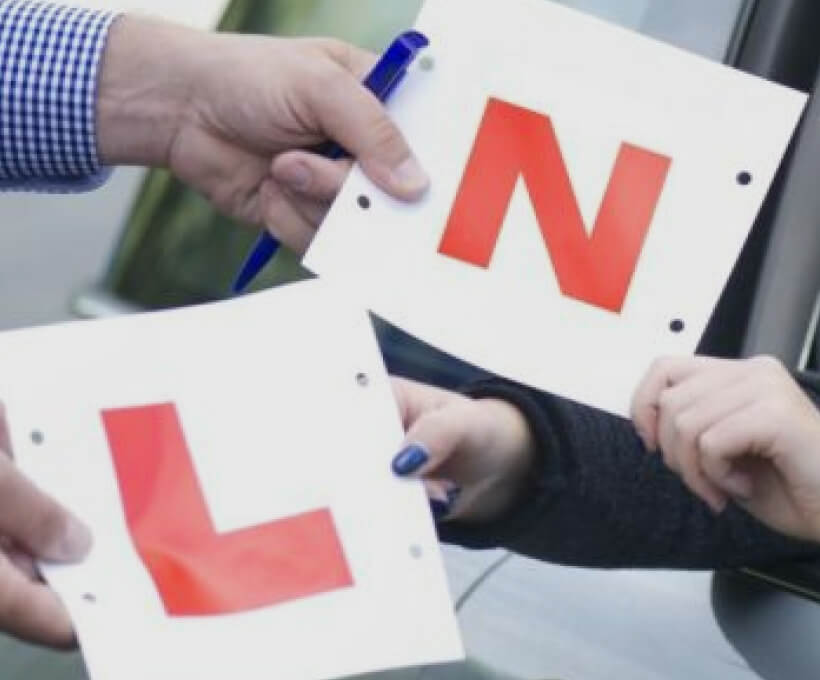
After the tester calls you, you will be invited to the office to sign a form to ensure that your vehicle is road worthy & fully insured. You will be asked to answer 8 Road Signs & 8 Questions on the Rules of the Road and 2 hands signs. Then you will walk with the tester to your vehicle, the Tester will ensure that your Vehicle is Fully insured, that your Road tax is up to date, L plates front & rear must be displayed & if your car is over 4 years old that the NCT must also be up to date. The Tester will ask you then to open the bonnet of your Vehicle & ask you the technical questions such as (Q): Where is your Oil filter cap, engine coolant, dipstick, brake fluid, windscreen washer & power steering. Then you will need to answer some practical questions such as:
Q) How to check your oil?
A) Pull dipstick Wipe it, put it back, pull it again & insure that oil level is between minimum & maximum?
Q) How frequently do you do it?
A) Once a week.
Q) How do you diagnose that your power steering is broken?
A) Steering will get stiff.
Q) How to check your engine coolant & brake fluid?
A) Read on the reservoir, between minimum & maximum. If levels are low, go to the closer mechanic.
Q) What pressure should you have on your tyres?
A) Check the car manual, but it is usually between 30 PSI & 35 PSI.
Q) How frequently do you check tyre pressure?
A) Once a week.
Q) What is the minimum tread on tyres?
A) 1.6 millimetre
When you will answer all questions, then the Tester will ensure that Brake light & indicator front & rear are working, if one the bulb is broken, be prepared to replace it, or else that will result as a failure as your vehicle is not road worthy.
Then you will be asked to demonstrate the cockpit secondary control as such as: Van, Hot & Cool air, Rear demister, Air condition (if fitted), Hazard light, Deam headlight, Fog light, Full head light, Front & (Back) wiper (if fitted), Windscreen washer.
You must also make sure that there is not a light on the dashboard when the engine is running or else that will result in a fail as your vehicle is not road worthy for your driving test.
Turing right & left
When you sit your driving test, it is really common that pupils fail because of lack of good practice turning right, left & at junctions. What the RSA are looking for is the following routine:
– When approaching a junction with a Stop Sign, you must look at Rear Mirror, Signal, look at Wing Mirror & Manoeuvre in good time. Known as (MSMM) routine. Regardless if it is clear to proceed or not, you must look right, left & right again before moving off.
– When approaching a Yield sign or a Yield line, you must use your MSM routine. Watch out for your position, slow down in good time & come down on appropriate gear (Automatic hold your brake in order to remain in control of your vehicle). Then you will have to Look in the junction, Assess & Decide, Known as (MSM-PSG-LAD) routine, you do not have to Stop completely unless there is some oncoming traffic coming either from your Right or left.
– If you are at a junction where the roads are of equal importance, the traffic on your right has the right of way. You must let the traffic pass before moving off. It is important to understand that the right of way is an absolute right. You must proceed with caution and look for other road users. If in doubt do not proceed.
– If you are turning right on a major road to a minor road, the oncoming traffic that is going straight has the right of way. You must wait for other roads to clear and proceed it is safe to do though.
– While turning in another direction, you must watch for pedestrians already crossing at the junction, pedestrian zebra or crossing, pelican crossing when the amber light is flashing.
By law, a driver must enter a roundabout by turning to the left. Treat it as a junction & give the right-of-way to traffic already on it.
Approaching roundabout
1) Decide as early as possible which exit you need to take.
2) Take note of & act on all the information available to you from traffic signs, traffic lights & road markings that direct you into the correct lane.
3) Remember the routine Mirror, Signal, Mirror, then Position, Speed, Gear & Look, assess & Decide.
4) Get into the correct lane when it is safe to do so. Try to imagine a clock =, 6 to 12 o’clock left lane, 12 to 6 o’clock right inside lane: Unless Road markings tell the other way.
5) Be aware of the speed & position of all traffic around you & adjust your speed to fit in with traffic conditions.
When you reach the roundabout.
– Give way to Traffic approaching from your right, unless signs, road marking or traffic lights tell you otherwise.
– Where traffic lights control the roundabout, you must obey them.
– You must obey any road markings on the lanes.
– Pay attention to vehicles already on the roundabout, watch out for their signals & judge where they plan to exit.
– Watch out for others users of the road & beware of vulnerable road user as such as cyclists, Escooter & motorcyclists
Coasting:
Coasting can be a habit that learner drivers acquire on a regular basis and need to take driving lessons to cure as excessive coasting will result in failing the Driving test. It is also dangerous.
Coasting means to move your vehicle, and make progress without using power. Coasting while driving means keeping the clutch fully pressed, i.e. free-wheeling and not using the engine to move.
1) When the clutch is depressed it disengages the engine, effectively making the car free-wheel. Keeping the engine engaged in
2) While driving without coasting it allows the car to slow down using the engine brake, reducing wear on the brakes and increasing control of the car making it safer.
Coasting in a car explained
While driving the most frequent use of coasting is when the driver is:
– To keep the clutch depressed while changing direction 🙁 making a left, right turn or at roundabout).
– To depress the clutch too soon before coming to a stop.
– To keep the clutch depressed too long after changing gears.
– To depress the clutch or keeping the gear in neutral in general driving to save on petrol
Coasting is potentially dangerous as it leads to less control of the vehicle. Keeping the clutch depressed while turning or negotiating a round-about will turn your vehicle into a free-wheeling go-cart as the engine is disengaged.
Heavy coasting is potentially dangerous, the Tester will mark you as you are not in control of your vehicle which may result as a fail for not driving safely. A little coasting here and there such as putting the clutch down a little too early before a stop occasionally will not fail a test but impose a minor fault and if repeated too often may result as a grade two.
In order to avoid coasting keep applying pressure on the foot brake until you reach an appropriate speed for the turn 25 Km/H, skip into second gear, release clutch while holding foot brake, release clutch half way to reach 20 Km/H, than release brake as the rotation of the second gear is engaging and take control of your vehicle.
When coming to a full stop in your vehicle, follow routine B-B-C (Brake, Before, Clutch Technique) to prevent coasting. As above, cover the brake and clutch, keep gently applying pressure to the brake. Good braking techniques such as progressive braking makes for safer driving, and reduces wear on braking systems and tyres and clutch in good time for a full stop of your vehicle. It is not necessary to change gears as this is an old technique that is not used in modern driving.
Progress:
When going for your Driving Test, progress can be nerve wrecking & a huge challenge that may make you fail your driving test. As an Approved Driver Instructor (ADI) please follow these tips.
1) When driving on the main road keep your speed up to 1 or 2 kilometres per hour above the speed required.
2) At junctions make sure to go to routine Mirror Signal Mirror Manoeuvre. Give proper observation & move in good time. If in doubt, Do not proceed (Listen to your instincts, the 1st one is usually the right thing to do)
3) When turning right in a busy junction, that can be challenging. So as the last vehicle is approaching, engage your Clutch the same way that you are doing your Hill start. It will make the vehicle move on quicker & change in second gear in good time.
4) On the approach to traffic lights, be aware – if a long time on the green Possible Change, so ease off your accelerator on your approach. If Light is turning Ambre & you are committed to it, proceed ( Do not slam on the Brakes it may result in a collision with other road users & get whiplash).
5) When turning right at a traffic light, always watch out for the light. If there is a straight Green arrow, stay behind road markings. If there is a green arrow (Filter Light) proceed if it is safe to do though. If it is a full green light, the vehicle must engage in the Filter Box or (where it should be). If the light is turning Ambre & you cannot proceed due to oncoming traffic, & eventually traffic light is turning Red you still have to proceed regarding it is safe to do though.
6) When at a red Traffic Light & you need to turn left, be aware of the Filter Light (Green Filter Light), if there is Filter Light. It is not always the case.
In order to keep good progress, stay confident & watch out for other Roads users.
Reverse on the left corner:
When you take your practical driving test, the Driver Tester will ask you to demonstrate a reverse on the Left Corner. Most pupils are dreading this manoeuvre for the Test.
You will required to have a good:
– Observation: (make good use of your mirrors, keep looking in the back window over your left shoulder, check your blind spot regularly).
– Yield to other road users: (if there is a vehicle coming in either direction, Stop as you create an obstruction on other road users).
– Position: keep reasonably close from the kerbs: (14 inches or 45 centimetres, which would be half the length of your vehicle door). And stop when you are instructed to.
To prepare for this manoeuvre, practice and supervision will be required for you to be confident while manoeuvre.
Turn about:
When you take your practical driving test, the Driver Tester will ask you to demonstrate a Turn About, also known as 3 point turn. Most pupils are dreading this manoeuvre for the Test.
While manoeuvring you must maintain reasonable progress & show consideration to other road users. Watch out for the safety of pedestrians. Be prepared to stop if it is safe to do so.
1) Most importantly parking of the vehicle for the maneuver is crucial, make sure that the vehicle is 1/4 length of a door from the kerb, 0,25 metres or 7 inches away from the kerb & at list 5 metres from a bend or a junct.